
Water Polo Drills
January 22, 2024

In water polo, both skill and technique are vital — from body positioning and ball handling to explosive swimming and defensive pressure. To execute effectively during a game, players need to build muscle memory through consistent, game-realistic practice. The drills below cover every core aspect of water polo training: conditioning, eggbeater strength, passing, shooting, defense, and game awareness. Each drill includes its in-game purpose so coaches and players understand exactly what they're building toward.
Eggbeater & Treading Water Drills
The eggbeater kick is the most fundamental skill in water polo — it keeps players afloat in an upright position while their hands are free to pass, shoot, and defend. Strong eggbeater technique underpins everything else. For a complete eggbeater technique breakdown, see our How to Eggbeater for Water Polo guide.
Eggbeater Progression Drill
Players: 1+ | Equipment: None | Level: All levels
In the deep end, tread water using the eggbeater kick through a progressive series of increasing difficulty. Each stage lasts 15–30 seconds with 10 seconds rest between:
- Hands sculling — Basic eggbeater with hands assisting for balance.
- Hands out of water — Eggbeater with hands held just above the surface.
- Elbows out of water — Arms bent, elbows clear of the surface.
- Arms fully extended overhead — The most demanding position, simulating a shot or block.
Purpose: Builds leg strength and endurance progressively. Players who can maintain a high body position with arms overhead have a massive advantage when shooting, blocking, and winning wrestling exchanges. Goalies should emphasize this drill heavily, as shot-blocking demands explosive vertical reach from an eggbeater base.
Weighted Eggbeater Drill
Players: 1+ | Equipment: Water polo ball or weighted ball | Level: Intermediate–Advanced
While treading water with the eggbeater kick, hold a ball (or weighted ball / water jug) above your head with both hands. Maintain shoulders-dry height while moving in all four directions — forward, backward, left, and right — across the width of the pool. Rest 15–20 seconds between each width.
Purpose: Develops the explosive leg drive and core stability needed for shooting, blocking, and wrestling while maintaining a high body position. Coaches commonly use heavy balls (like the KAP7 heavy trainer) to build strength, then switch to regular game balls so the shot feels effortless by comparison.
Conditioning Drills
Water Jumping-Jacks
Players: 1+ | Equipment: None | Level: All levels
Swim five meters at maximum effort, come to a complete stop, then explode as high out of the water as possible (clapping hands overhead). Immediately resume swimming another five meters and repeat. Execute across the full length of the pool. Rest as needed between sets.
Purpose: Recreates one of the most common in-game sequences — a short, explosive sprint followed by a max-height vertical jump. On defense, this translates to driving into your opponent and leaping to block a shot, prevent a pass, or steal the ball. On offense, this mirrors a drive-to-shot where the attacker must sprint and then elevate to get a clear shooting angle over a defender.
Water Polo Individual Medley
Players: 1+ | Equipment: None | Level: All levels
Perform a single lap of each of the following swim styles, back to back without rest:
- Butterfly — Full-body conditioning; builds the explosive power used in lunging and wrestling.
- Head-up backstroke — Simulates traveling down-field while visually tracking ball location behind you.
- Waist-high bulldog — Mimics the high-body defensive posture when approaching an offensive player ("bulldogging" is swimming with head and shoulders elevated).
- Head-up freestyle — The foundation of water polo swimming. Essential for dribbling, driving, and maintaining field awareness of the ball and other players' positions.
Purpose: Each stroke develops a specific water polo skill. Head-up swimming is particularly critical — unlike competitive swimming, water polo players almost never put their face in the water during a game, because field awareness is everything.
Sprint–Tread Intervals
Players: 1+ | Equipment: None | Level: Intermediate–Advanced
Sprint 12–15 meters head-up freestyle, then immediately transition to vertical eggbeater treading for 10–15 seconds with hands out of the water. Repeat this cycle 4–6 times across the pool without resting on the wall. One full set = one complete pool crossing.
Purpose: This is the single most game-realistic conditioning drill. In a match, players constantly alternate between horizontal swimming (sprinting to position) and vertical treading (holding position, wrestling, passing, shooting). The transition between horizontal and vertical body position — "hips from horizontal to vertical" — is one of the most energy-demanding elements of the sport.
Ball-Handling & Passing Drills
Catch-and-Pass Fundamentals
Players: 2+ | Equipment: 1 water polo ball | Level: Beginner
Two players face each other approximately 3 meters apart, treading water. Pass the ball back and forth using the dominant hand, focusing on: high elbow position, snapping the wrist on release, and catching with fingertips spread (not palming the ball). After 2–3 minutes, switch to the non-dominant hand. Gradually increase distance to 5, then 8 meters.
Purpose: Passing and catching are the most fundamental ball skills in water polo. This drill builds proper technique before adding game pressure. Developing the off-hand (non-dominant hand) is especially important — defenders can shut down one-dimensional passers who can only throw with their strong hand.
180-Degree Passing
Players: 3+ | Equipment: 1 ball | Level: Intermediate
Station three players in a straight line from cage to cage, evenly spaced. One outside player passes to the middle player (who is facing them). The middle player catches, spins 180 degrees, and passes (or performs a no-look shot) to the player on the opposite side. That player catches and passes back to the middle player, who again spins 180 degrees to the other side. Rotate positions every 3–5 minutes.
Purpose: Quick 180-degree turn-to-passes are a crucial skill for moving the ball quickly down-field. If your goalie is being pressed and can't make an accurate long pass to a teammate on a breakaway, a player in the middle of the field can act as a cut-off, intercepting the pass and redirecting with a quick spin for better accuracy or a change of play.
Hot Potato (6-on-5 Passing)
Players: 6+ (plus goalie) | Equipment: 1 ball, 1 goal | Level: Intermediate–Advanced
Set up in a standard six-on-five offensive formation. Start a descending 20-second shot clock. Players pass the ball rapidly among each other — no player can hold the ball for more than 2 seconds. When the clock expires, the player with the ball must immediately shoot on goal.
Purpose: Drawing a kick-out (exclusion) creates a crucial 6-on-5 power play advantage, but only if the offense capitalizes with fast, accurate passing. This drill builds the quick-release passing and constant player movement that power plays demand. Staggering the 2-meter wings with the post players often creates better passing angles — experiment with different formations during this drill.
Shooting Drills
Wrestle & Shoot
Players: 4+ (including goalie) | Equipment: 5 balls, 1 goal | Level: Intermediate–Advanced
One player positions himself cross-cage with five water polo balls. Two other players set up cross-cage, one in an offensive position and the other on defense. The offensive and defensive players wrestle in the water for 30 seconds. When the whistle sounds, they stop wrestling. Immediately, the cross-cage player passes five rapid pass-to-shots to the offensive player on goal.
Purpose: This drill conditions accuracy under fatigue — the most game-realistic shooting scenario. In-game shots on goal almost never come from a rested, passive state. The offensive player has to physically earn the opening through wrestling and positioning before getting the chance to shoot. Training the mind and body to be accurate while exhausted is what separates good shooters from great ones.
Goalie Rapid-Fire Drill
Players: 3+ (including goalie) | Equipment: 5–10 balls | Level: All levels
Line up 2+ shooters at the 5-meter line, each with multiple balls. Shooters take turns firing at the goal in rapid succession — a new shot every 3–5 seconds from alternating angles (left wing, center, right wing). The goalie must reset and react between each shot without pausing.
Purpose: Develops goalie reflexes, positioning, and recovery speed. In-game, goalies face shots from multiple angles in quick succession, especially during power plays and counter-attacks. This drill also benefits shooters by forcing them to read the goalie's position and pick their spots quickly.
Offensive & Defensive Drills
Sprint to Ball: Winner Attacks
Players: 2+ | Equipment: 1 ball, 2 goals | Level: All levels
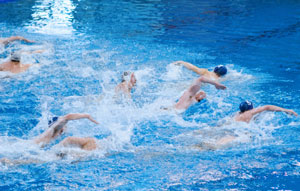 After throwing the ball into the middle of the pool, both players position themselves touching their respective goal posts. On the whistle, both players sprint to the floating ball. The first player to reach the ball takes offense; the other takes defense. The offensive player drives with the ball toward the opposite cage to score, while the defensive player tries to catch up and steal the ball. The defender should focus on skillfully stealing the ball rather than drawing fouls or kick-outs.
Purpose: Besides the obvious conditioning benefit of repeated full-pool sprints, this drill develops multiple game skills simultaneously. Offensive players practice dribbling under pressure with a defender close behind, taking wet shots, and drawing fouls. Defensive players practice chase-down speed, approaching an attacker from behind, and clean ball-stealing technique without fouling. Dribbling with a close defender is one of the most common in-game situations.
Counter-Attack Drill (2-on-1)
Players: 3+ (including goalie) | Equipment: 1 ball, 1 goal | Level: Intermediate
Two offensive players start at half-pool. One defensive player starts between them and the goal. The ball is passed to one of the attackers, and the two offensive players drive toward the goal while the single defender tries to slow the attack. The offense must use passing and movement to create a clear shot before the rest of the defense (imaginary or real) can recover.
Purpose: Counter-attacks (fast breaks) are among the highest-percentage scoring opportunities in water polo. This drill teaches offensive players to move the ball quickly, read the defender's positioning, and make the right decision — shoot or pass — under time pressure. For the defender, it builds the critical skill of delaying the attack and forcing the offense into a lower-percentage shot.
Red Light, Green Light
Players: 2+ (plus coach) | Equipment: None | Level: Beginner–Intermediate
Players line up at one end of the pool facing down-field, with the coach at the opposite end. On the coach's "green light" command, players swim toward the coach. On "red light," they stop immediately. The coach calls stops and starts at random intervals, and can also call out specific actions: jumping-jacks, lunges left/right, bulldogs, eggbeater with hands up, or 360-degree spins.
Purpose: Water polo games are sporadic and ever-changing. Constant steals, turnovers, shots, fouls, and kick-outs make play physically demanding and unpredictable. This drill trains reaction time, body control, and the ability to transition between different movements on command — the same awareness players need when responding to the referee's whistle and rapidly shifting game situations.
Dryland Training for Water Polo
In-water drills are the core of water polo training, but dryland (out-of-water) exercises build the strength foundation that makes everything in the pool more effective. Key exercises for water polo players include:
- Squats and lunges — Build the quadriceps and glute strength that powers the eggbeater kick and explosive vertical jumps.
- Box jumps — Develop fast-twitch muscle fibers and explosive power for shots, blocks, and wrestling.
- Wall sits — Build quadriceps endurance; hold a 90-degree angle for 30–60+ seconds, mimicking the isometric leg demands of sustained eggbeater.
- Core work (planks, Russian twists, medicine ball throws) — Core stability is essential for generating throwing velocity while treading water, where there's no solid ground to push against.
- Resistance band rotator cuff exercises — Water polo involves high-volume overhead throwing, which puts stress on the shoulder. Preventive rotator cuff work reduces injury risk.
How to Structure a Water Polo Practice
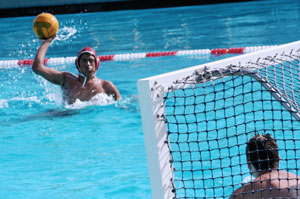
A well-structured 90-minute water polo practice typically follows this progression:
- Warm-up swim sets (10–15 min) — Freestyle, backstroke, and head-up swimming to elevate heart rate.
- Eggbeater/leg work (10 min) — Treading progressions, weighted eggbeater, or vertical kicks.
- Ball-handling & passing (15 min) — Partner passing, 180-degree drills, catch-and-release work.
- Shooting drills (15 min) — Wrestle & shoot, rapid-fire, angle shooting.
- Team tactics / game-situation drills (15 min) — 6-on-5, counter-attacks, defensive positioning.
- Scrimmage (15–20 min) — Full or modified scrimmage, keeping score to maintain competitiveness.
- Cool-down (5 min) — Easy swimming and stretching.
Vary the focus each day — one day emphasize conditioning and leg strength, the next focus on passing and shooting technique, and another on team tactics. Keeping practices varied prevents burnout and ensures comprehensive skill development.
Essential Water Polo Equipment
To run these drills effectively, you'll need the right gear:
- Water polo balls — Official size 5 (men's) or size 4 (women's). Having 5–10 balls available speeds up shooting drills significantly. See our ball size guide for all sizes.
- Water polo caps — Required for scrimmages and game-situation drills. Two sets of different colors for team identification.
- Water polo goals — Full-size (3m × 0.9m) for regulation practice, or smaller portable goals for limited space.
- Water polo swimwear — Durable suits designed to withstand grabbing and physical play. Women's suits typically feature thicker straps and reinforced construction.
- Swim goggles — Used for warm-up swim sets (not worn during water polo play). See our goggles guide.
Shop All Water Polo Swimwear & Gear →
FAQs
What are the best water polo drills for beginners?
Beginners should focus on three fundamentals: eggbeater technique (start with the progression drill, building from hands-sculling to hands-out), basic catch-and-pass with a partner at short range (3 meters), and head-up freestyle swimming. Once these three skills are comfortable, add sprint drills, shooting practice, and game-situation exercises. The Red Light, Green Light drill is also excellent for beginners because it builds reaction time and body control in a fun, competitive format.
How do I improve my eggbeater kick for water polo?
Practice the eggbeater progression drill regularly — start with hands sculling, then progress to hands out, elbows out, and finally arms extended overhead. Add weighted eggbeater drills once you can sustain 30+ seconds with hands out. Outside the pool, squats, lunges, and wall sits build the quad and hip strength that powers the eggbeater. For a full technique breakdown, see our eggbeater guide.
How long should a water polo practice be?
Most competitive water polo practices run 90 minutes to 2.5 hours, depending on the level. Youth and beginner teams typically practice 60–90 minutes. High school and club teams average 90–120 minutes. College and elite programs may practice 2–2.5 hours, often starting with a full hour of swim conditioning before moving to ball work and tactics.
What conditioning do water polo players need?
Water polo demands both aerobic endurance (players swim 1,500–1,650 meters per match) and anaerobic power (330+ direction changes, repeated sprints under 15 seconds). Training should include swim sets for aerobic base, sprint–tread intervals for game-specific conditioning, eggbeater endurance for sustained treading, and dryland strength work (squats, box jumps, core) for explosive power.
How can I practice water polo alone?
Solo drills include: eggbeater progression and weighted treading, water jumping-jacks, sprint–tread intervals, the individual medley drill, and ball-handling work against a wall (throw and catch with both hands). You can also practice shooting accuracy by placing targets in the goal corners. Head-up freestyle swimming is always valuable solo conditioning.
What drills improve water polo shooting accuracy?
The Wrestle & Shoot drill is the most game-realistic shooting exercise because it forces accuracy under fatigue. For accuracy-specific work, hang caps on the goal crossbar as targets and practice hitting them from different angles and distances. "Rapid-fire" drills where a coach feeds balls in quick succession build the fast decision-making shooters need. Always practice with both your dominant and non-dominant hand.
What size water polo ball should I use for drills?
Men (14+) use a size 5 ball, women (14+) use a size 4, and younger players use size 3 or smaller depending on age. For strength-building drills, heavy trainer balls (overweight balls designed for training) add resistance that makes the regular game ball feel lighter. See our complete water polo ball size guide.
~
This guide is written and maintained by the SwimOutlet team. For more water polo resources, explore our eggbeater technique guide, ball size guide, pool dimensions guide, and competitive swimming rules.