

Understanding the Difference Between Swim Resistance Gloves and Swim Paddles
January 22, 2024

The broad category of "pull gear" in swim training accessories is designed to engage your upper body, build arm and shoulder strength, and de-emphasize — or completely eliminate — forward propulsion from your legs. Pull sets are a cornerstone of structured swim training, used by everyone from fitness swimmers to Olympians to develop a more powerful, efficient stroke.
The two main types of pull equipment for your hands are swim paddles and swim resistance gloves. While they serve a similar broad purpose — creating more resistance between your hands and the water — they're actually very different tools with distinct benefits, use cases, and trade-offs.
This guide from the SwimOutlet team explains the key differences between swim paddles and resistance gloves, the types of paddles available, when to use each, and how to incorporate them safely into your training. We also cover the pull buoy — the third piece of the pull-gear equation that most swimmers pair with paddles or gloves.
How Pull Gear Works: The Basics
For most pull sets, you'll wear a pull buoy — a foam float held between your thighs — to elevate your legs and hips while they remain inactive. This isolates your upper body, forcing your arms, shoulders, back, and core to do all the work. On top of the pull buoy, you'll add either paddles or gloves to increase the resistance your hands encounter during each stroke.
Both paddles and gloves increase the surface area of your hands, which means you displace more water with every pull. This added resistance builds upper-body strength and power in a swim-specific way — your muscles are trained in the exact motion they use during racing. The result? A stronger catch, a more powerful pull, and better "feel" for the water when the equipment comes off.
Swim Resistance Gloves
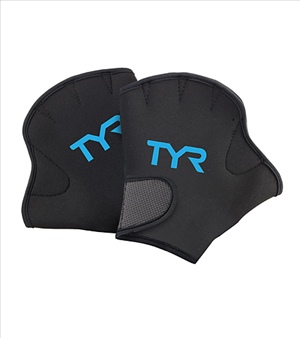
Swim resistance gloves are made of neoprene and look like standard gloves — but with webbing between each finger that dramatically increases the amount of water you grab with each stroke. Unlike rigid plastic paddles, gloves are soft, flexible, and allow your hands to move naturally throughout the pulling motion.
Key Benefits of Swim Gloves
- Natural hand mobility: Because the glove is flexible, your fingers and wrists maintain their full range of motion. This makes gloves significantly safer for strokes that require complex hand movements — particularly breaststroke and butterfly, where rigid paddles can place dangerous stress on the shoulder joint.
- Lower injury risk: The softer neoprene material creates resistance without locking your hand into a fixed position. For swimmers with a history of shoulder issues, or those concerned about injury prevention, gloves are the safer choice.
- Water aerobics and aqua fitness: Swim gloves are a staple in water aerobics classes, where the goal is general resistance training rather than swim-specific technique work. The webbing adds resistance to arm movements in every direction — forward, backward, lateral, and rotational.
- Warmth in cold water: Because they're made of neoprene (the same material used in wetsuits), swim gloves also provide insulation for open-water swimming and cold-pool sessions.
Best For
Breaststroke and butterfly pull work, water aerobics, fitness swimming, swimmers with shoulder sensitivity, cold-water swimming, and beginners who want added resistance without the technique demands of rigid paddles.
Swim Paddles
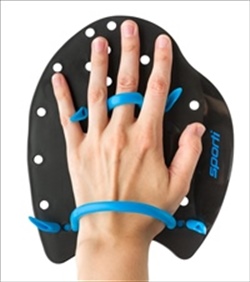
Most swimmers are probably more familiar with swim paddles — they're the most common piece of pulling equipment on every pool deck. Paddles are flat or slightly curved pieces of durable plastic that attach to your hand via silicone straps around the fingers and (optionally) the wrist. They come in a wide range of sizes, from barely larger than your hand to the size of a small lunch plate.
Key Benefits of Swim Paddles
- Strength and power development: Paddles are the most effective tool for building swim-specific upper-body strength. The rigid surface prevents water from slipping through your fingers, forcing your shoulders, lats, chest, and arms to work significantly harder with every stroke. Think of it like resistance training built directly into your swim.
- Technique feedback and correction: This is where paddles really differentiate themselves from gloves. Because they're rigid, paddles provide instant feedback on your stroke mechanics. If your hand enters the water at the wrong angle, the paddle will catch or slip off. If you don't engage an early vertical forearm (EVF) catch, the paddle won't seat properly. This real-time feedback trains better habits — something flexible gloves can't replicate.
- Increased speed: Swimming with paddles lets you experience race-pace (or faster) speeds during training. This builds neuromuscular familiarity with moving at high speeds, which translates to faster swimming when the paddles come off.
- Stroke lengthening: Paddles encourage a longer, more complete pull through the water. You'll reach further forward on the catch and pull all the way through to full extension — improving your distance per stroke (DPS), one of the most important efficiency metrics in competitive swimming.
Types of Swim Paddles
Not all paddles serve the same purpose. Here's a breakdown of the main categories:
- Standard hand paddles (flat, medium-sized): The classic all-rounder. Cover the full palm with adjustable finger and wrist straps. Great for general strength building and freestyle/backstroke technique. Brands like Speedo, TYR, FINIS, and Sporti all offer excellent options. This is where most swimmers should start.
- Finger paddles (small, fingertip-only): Cover only the fingers, leaving the palm exposed. These are the best starting point for beginners — they provide technique feedback with minimal added resistance, putting far less stress on the shoulders. They're excellent for improving hand entry and catch awareness.
- Strapless / technique paddles: Paddles like the FINIS Agility Paddle have no straps at all — they stay on your hand purely through correct water pressure. If your technique is off, the paddle falls off immediately. This is the ultimate technique-feedback tool and a favorite among coaches for drilling proper catch mechanics.
- Forearm paddles: Extend from the fingertips past the wrist, covering the hand and forearm. These are designed specifically to teach the high-elbow catch (early vertical forearm) — a critical freestyle technique that many swimmers struggle with. These are the largest paddles and should be used sparingly and under coach guidance.
- Contoured / ergonomic paddles: Curved to match the natural shape of the hand. These feel more natural in the water and are popular for swimmers who want the benefits of paddles without altering their hand position. Good for all four strokes.
Choosing the Right Paddle Size
Size matters — and bigger is not better. Division I swimming coach Marc Christian recommends that swimmers "start with paddles that are slightly larger than their hands." Oversized paddles add excessive stress to the shoulder joint and can cause injury, especially for swimmers with developing technique. As your strength and mechanics improve, you can gradually increase paddle size for power-focused sets.
General sizing guideline:
- Beginners: Finger paddles or small technique paddles
- Intermediate swimmers: Medium paddles (slightly larger than the hand)
- Advanced / competitive swimmers: Full-size paddles for power sets; technique paddles for drill work
Best For
Freestyle and backstroke training, competitive swim technique development, upper-body power building, speed work, stroke-specific drill sets, and experienced swimmers who want measurable performance gains.
Swim Paddles vs. Resistance Gloves: Quick Comparison
| Feature | Swim Paddles | Resistance Gloves |
|---|---|---|
| Material | Rigid plastic | Flexible neoprene with webbing |
| Hand mobility | Limited (fixed position) | Full natural range of motion |
| Resistance level | Higher (adjustable by size) | Moderate (fixed by webbing) |
| Technique feedback | Excellent — instant correction | Minimal |
| Shoulder injury risk | Higher (especially if oversized or used with poor technique) | Lower (flexible, forgiving) |
| Best strokes | Freestyle, backstroke (all strokes for advanced swimmers) | All strokes, especially breaststroke and butterfly |
| Ideal users | Competitive swimmers, technique-focused training | Water aerobics, fitness swimmers, beginners, injury-conscious swimmers |
| Price range | $8–$30+ | $10–$20 |
The Pull Buoy: The Third Piece of Pull Gear
No pull set is complete without a pull buoy. This hourglass-shaped foam float is placed between your thighs to keep your hips and legs elevated while your arms do all the work. By eliminating your kick, the pull buoy forces your upper body to be the sole source of propulsion — isolating and strengthening the muscles that power your pull.
Pull buoys also improve body position awareness. If your core isn't engaged or your hips drop, you'll feel it immediately. For beginners, swimming with a pull buoy can actually be easier than regular swimming because it takes the kick out of the equation and lets you focus entirely on your arm stroke and breathing.
Most swimmers pair a pull buoy with paddles or gloves for a complete upper-body training set. Some also add an ankle band or swim snorkel to further isolate specific elements of the stroke.
How to Use Paddles and Gloves Safely
Pull equipment is tremendously beneficial — but it must be used correctly to avoid injury. Here are the most important safety and training guidelines:
- Start small, build gradually. If you've never used paddles before, begin with finger paddles or small technique paddles. Don't jump straight to full-size power paddles — the added stress on your shoulders can cause tendinitis or rotator cuff irritation.
- Limit your volume. The MySwimPro coaching team recommends keeping total equipment usage (paddles, fins, and other gear combined) to less than 50% of your weekly training volume. For paddles specifically, targeted sets of 400–800 yards per workout is a good starting point.
- Remove the wrist strap. Once you're comfortable with paddles, try swimming with only the finger strap. This forces you to maintain proper technique throughout the pull — if your catch is off, the paddle slips off. It's uncomfortable at first, but it's one of the most effective technique-building drills in swimming.
- Listen to your shoulders. Shoulder pain is a stop sign, not a speed bump. If you feel discomfort in your shoulders while using paddles, stop immediately. The issue may be paddle size (too large), technique (poor catch), or volume (too much too soon). Consult a coach or swim-trained physical therapist before continuing.
- Don't rely on equipment. Paddles and gloves are training tools, not crutches. Alternate equipment sets with regular swimming to ensure the strength and technique gains transfer to your unequipped stroke.
Frequently Asked Questions
Should I get paddles or gloves as a beginner?
For most beginner lap swimmers, swim gloves are the safer starting point — they add resistance without the technique demands and shoulder stress of rigid paddles. If your primary goal is technique improvement (not just resistance), consider finger paddles instead — they provide feedback on hand entry with minimal shoulder load. If you do water aerobics or aqua fitness, gloves are the clear choice.
Can swim paddles cause shoulder injuries?
Yes — if used incorrectly. The most common causes of paddle-related shoulder injuries are: using paddles that are too large, swimming with poor technique (especially a dropped elbow catch), and doing too much paddle volume too soon. Start small, focus on technique, and build volume gradually. If you have existing shoulder issues, use gloves or finger paddles instead.
Do I need a pull buoy to use paddles?
Not strictly — you can use paddles while kicking normally. However, most swimmers pair paddles with a pull buoy for dedicated pull sets, as this isolates the upper body and maximizes the strength-building benefit. Using paddles with a normal kick is also a valid training approach, especially for working on speed and full-body power.
What size swim paddle should I get?
Start with a paddle that is only slightly larger than your hand. Oversized paddles are a common mistake — they feel powerful but dramatically increase shoulder stress. As a general rule, your paddle should extend no more than about 1 inch beyond your fingertips and the edges of your palm. Once your strength and technique improve, you can experiment with larger sizes for specific power sets.
Can I use swim paddles for all four strokes?
Entry-level and intermediate swimmers should primarily use paddles for freestyle and backstroke — these strokes have a linear pulling motion that paddles support well. Breaststroke and butterfly involve more complex hand and wrist movements that rigid paddles can interfere with, potentially causing shoulder injury. Advanced swimmers with excellent technique can use paddles for all four strokes, but should use ergonomic or contoured designs for breaststroke and butterfly.
Find Your Perfect Pull Gear
Whether you choose paddles, gloves, or both, adding pull equipment to your training mixes up your workouts, builds swim-specific strength, and teaches you the power of a controlled, efficient upper-body stroke. The right tool depends on your goals, experience level, and the strokes you swim most.
Shop Swim Paddles & Resistance Gloves | Shop Swim Paddles | Shop Resistance Gloves | Shop Pull Buoys | Shop All Swim Gear


